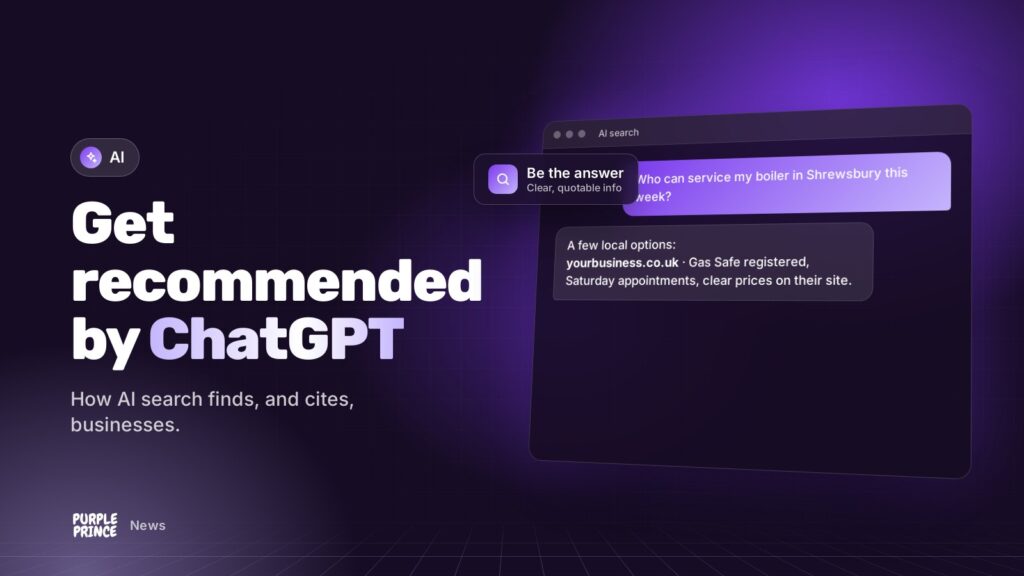
More of your customers are asking ChatGPT or Google’s AI answers “who’s a good plumber near me?” instead of scrolling a list of links. So how do you make sure your business is the one that gets mentioned?
In short: To get recommended by ChatGPT and AI search, your site must be crawlable and indexed, answer customer questions clearly, use accurate structured data, keep business details consistent everywhere, and earn genuine reviews. There’s no secret trick: AI search mostly rewards the same things good SEO always has.
How do AI assistants find and recommend businesses?
When ChatGPT searches the web, OpenAI says it uses its own search crawler, called OAI-SearchBot, and sometimes other search providers too. It turns your question into one or more searches, reads the results and writes an answer with links to its sources.
Google’s AI Overviews and AI Mode work in a similar way. Google describes a “query fan-out” technique: running several related searches across subtopics, then pulling the answer together. Both draw on pages that are already indexed in search.
The upshot? If search engines can’t find and understand your site, AI assistants can’t either.
What is GEO (AI search optimisation)?
GEO stands for generative engine optimisation. It’s a newer label for making your business easy for AI assistants to find, understand and cite. You’ll also hear “AEO” (answer engine optimisation). Ignore the alphabet soup: it’s mostly good SEO with extra care over clarity and consistency.
AI search doesn’t reward tricks. It rewards businesses that are easy to understand and easy to trust.
How to get recommended by ChatGPT: 7 practical steps
1. Make sure AI crawlers are allowed in
OpenAI says sites that block OAI-SearchBot won’t be shown in ChatGPT search answers. Check your robots.txt file (the instructions file for crawlers) and any firewall or CDN settings. Note that GPTBot, OpenAI’s crawler for model training, is separate, so you can block training while staying visible in search.
2. Answer real questions clearly on your site
AI assistants love pages that answer a question directly. Lead with a short, plain answer, then add the detail. Useful pages include:
- Service pages that say exactly what you do, for whom and where.
- An honest FAQ section covering the questions customers actually ask.
- Guides that explain how things work in your industry.
3. Add accurate structured data
Structured data (often called schema markup) is behind-the-scenes code that labels your content: this is a business, here’s its address, these are its opening hours. Google is clear there’s no special schema needed for its AI features, but it does say your structured data should match what’s visible on the page.
4. Keep your business details consistent everywhere
Your name, address, phone number and services should match across your website, Google Business Profile, social profiles and directories. Inconsistent details make it harder for any system to be confident it’s talking about the same business.
5. Earn genuine reviews
Reviews on well-known platforms are public evidence that real people rate you. Ask happy customers, make it easy, and reply to reviews, good and bad. Never buy or fake them.
6. Get mentioned in the right places
Local news, trade bodies, supplier pages and industry directories all help show who you are and what you do. Focus on relevant, reputable places rather than chasing quantity.
7. Consider an llms.txt file, with realistic expectations
llms.txt is a proposed convention, suggested in 2024 by Jeremy Howard of Answer.AI. It’s a plain Markdown file at the root of your site that gives AI tools a tidy summary of your most important pages.
It’s not an official standard, and Google says you don’t need AI text files to appear in its AI features. It’s cheap to add, but don’t expect miracles.
What shouldn’t I do to get into AI answers?
- Don’t stuff keywords or write pages “for the robots”. AI tools are very good at spotting waffle.
- Don’t publish piles of thin AI-generated pages. Volume without substance won’t help, and Google’s spam policies cover scaled low-value content.
- Don’t hide text or show AI crawlers different content from what visitors see.
- Don’t fake reviews or invent credentials. It’s dishonest, and it can land you in trouble.
- Don’t trust anyone promising guaranteed AI rankings. Nobody controls what ChatGPT or Google’s AI says.
How do I check if AI search mentions my business?
Ask the questions your customers would: “best [your service] in [your town]”, “who sells [your product] in the UK?”. Try a few assistants, note who gets mentioned and which pages are cited. Repeat every couple of months, because answers change.
If a competitor keeps appearing, look at their cited pages. Often they’ve simply answered the question more clearly than you have.
Where do we fit in?
Most of this comes down to a well-built, fast, clearly written website with sensible technical foundations. Our SEO work covers structured data, crawlability and content, and our AI for business service helps you use AI sensibly across the rest of your business too.
If your site’s struggling to get found at all, it might be time for a refresh through our website design team.
Want a straight answer on whether AI assistants can find you? Get in touch for a no-obligation chat.