Picking an ecommerce platform is a bit like picking a van for your business. Buy the wrong one and you’ll either be paying for space you never use, or squeezing stock into a vehicle that’s far too small.
In short: Shopify suits shops that want to get selling quickly without touching servers. WooCommerce suits businesses already happy on WordPress who want a flexible, content-led shop. Magento suits growing or complex stores with big catalogues, B2B needs or custom rules. The best choice depends on control, growth plans and who’ll look after it.
What’s the real difference between Magento, Shopify and WooCommerce?
The biggest difference is who’s in charge of the engine. Shopify is a hosted service, often called SaaS (software as a service). You rent the platform, Shopify runs the servers and you build on top of what they allow.
WooCommerce and Magento are open-source software. You (or your developer) install them on hosting you choose, and you can change pretty much anything. That’s more control, but also more responsibility.
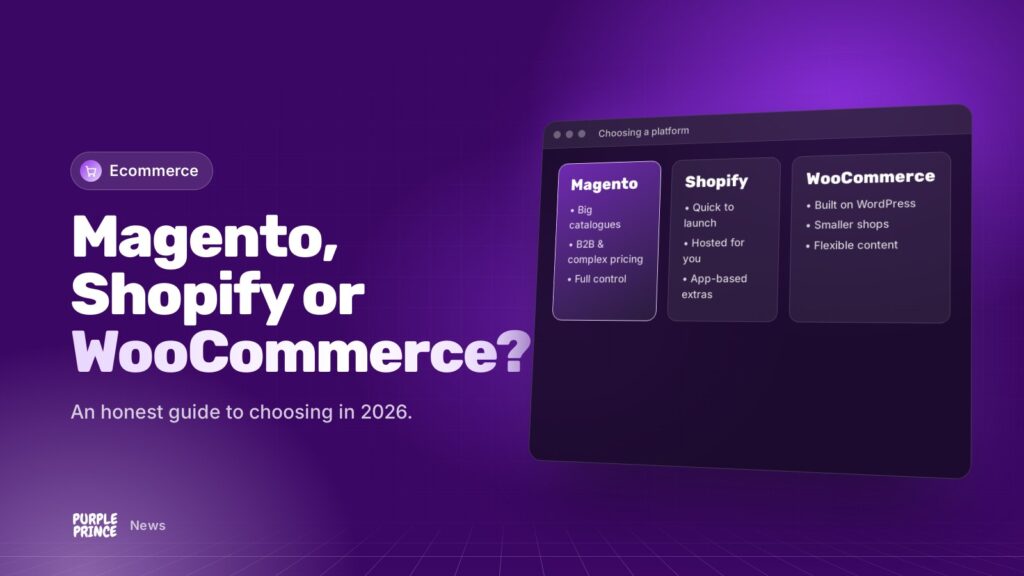
- Shopify: hosted, tidy, quick to launch, with an app store for extras.
- WooCommerce: a plugin that turns a WordPress site into a shop. Great for content and blogging.
- Magento: a dedicated ecommerce platform (Magento Open Source, or Adobe Commerce for the paid enterprise edition) built for larger catalogues and complex selling.
Who is each platform best for?
Shopify
Shopify’s brilliant for getting a straightforward shop live fast. If you sell a sensible number of products, want someone else to worry about servers and security, and are happy working within the platform’s rules, it’s a strong pick.
The trade-off is control. Checkout, URL structure and some data handling work the Shopify way. Lots of features come from third-party apps, and those add up over time.
WooCommerce
WooCommerce makes sense if your website is already on WordPress, or if content is a big part of how you sell. Recipes, guides, blogs, courses: WordPress handles all of that beautifully, and the shop sits right alongside it.
It’s flexible, but the more plugins you bolt on, the more there is to update and keep compatible. Good hosting and regular care matter.
Magento
Magento shines when your shop isn’t simple. Thousands of products, multiple stores or currencies, configurable products, customer-specific pricing, trade accounts, complex shipping rules. It’s built for that sort of thing out of the box.
It needs more expertise to build and run well, and it wants decent hosting. In the right hands, though, it’ll grow with you for years.
The cheapest platform to launch on isn’t always the cheapest platform to live on.
How do running costs compare, in plain English?
We won’t quote numbers here, because every shop is different. But it helps to think about cost of ownership: what you’ll spend over several years, not just on launch day.
- Shopify has predictable monthly plan fees, plus paid apps, themes and, depending on how you take payments, transaction fees. Costs creep up as you add apps.
- WooCommerce has no licence fee for the core plugin, but you’ll pay for hosting, premium extensions, and someone to keep it updated and secure.
- Magento Open Source also has no licence fee, but it needs specialist development, solid hosting and ongoing support. Adobe Commerce adds a licence on top.
Put simply: Shopify front-loads convenience, while Magento and WooCommerce front-load flexibility. Neither is wrong.
Which scales best as you grow?
All three can handle healthy traffic when set up properly. The question is really about complexity rather than visitor numbers.
Shopify scales smoothly for traffic because it’s their infrastructure. Where it can pinch is when your business rules get unusual. WooCommerce can scale well, but it depends heavily on hosting and how lean the plugin setup is.
Magento is built for big catalogues and multi-store setups, and with good hosting and caching it handles serious volume. That’s why so many established merchants pick it.
Which platform is best for B2B and trade selling?
B2B (business-to-business) selling usually means company accounts, trade price lists, quotes and ordering on account. Here’s how they stack up.
- Shopify keeps its native B2B features, such as company accounts and B2B price catalogues, on its top Shopify Plus plan. On other plans, trade selling usually means adding apps.
- WooCommerce handles B2B through extensions. It works, but you’re stitching pieces together.
- Magento handles customer groups and tiered pricing as standard, and Adobe Commerce adds a full B2B toolkit with company accounts, shared catalogues and quotes.
If trade customers are a big part of your business, Magento is usually the comfortable fit.
What about hosting, security and updates?
With Shopify, hosting and platform security are handled for you. That’s a genuine plus for small teams.
With WooCommerce and Magento, hosting is your call, which is both the benefit and the job. Pick hosting tuned for the platform and keep on top of security patches. Our Magento hosting runs on our own NGINX and PHP-FPM stack, with daily off-site backups and 24/7 monitoring, so that part’s sorted.
Magento vs Shopify vs WooCommerce: how do I actually decide?
Ask yourself these questions honestly:
- How many products do you sell, and how complicated are they?
- Do you sell to trade customers as well as the public?
- How much do you want to customise checkout, pricing or integrations?
- Who’ll look after updates and security: you, a developer, or the platform?
- Where do you want to be in three to five years?
Simple catalogue and want zero server worries? Shopify. Content-led and already on WordPress? WooCommerce. Complex, growing or B2B-heavy? Magento’s built for you.
We’re certified Magento developers and we also build with WordPress and WooCommerce, so we’re happy to talk through both. Have a look at our ecommerce development work, or read why we rate Magento 2.
Not sure which way to jump? Get in touch for a no-obligation chat and we’ll give you a straight answer.