PHP 8.5 landed in November 2025, and it’s the kind of release that makes developers grin and business owners ask “so what?” Fair question. Here’s the honest answer, for both of you.
In short: PHP 8.5 was released on 20 November 2025. The headline PHP 8.5 new features are a pipe operator for cleaner code, a built-in URI extension for handling web addresses safely, and easier ways to copy objects. It’s supported until the end of 2029, so it’s a sensible long-term target for upgrades.
What is PHP 8.5, in plain English?
PHP is the language that runs behind WordPress, WooCommerce, Magento, Laravel and a big slice of the web. Every year or so the PHP team ships a new version with new features, tidy-ups and speed improvements.
PHP 8.5 is the newest of those. According to the official supported versions page, it gets active support until 31 December 2027 and security fixes until 31 December 2029. That’s a long runway.
What are the PHP 8.5 new features that actually matter?
There’s a long list of PHP 8.5 new features in the release notes. These are the ones we think are worth knowing about, whether you write code or pay the people who do.
The pipe operator
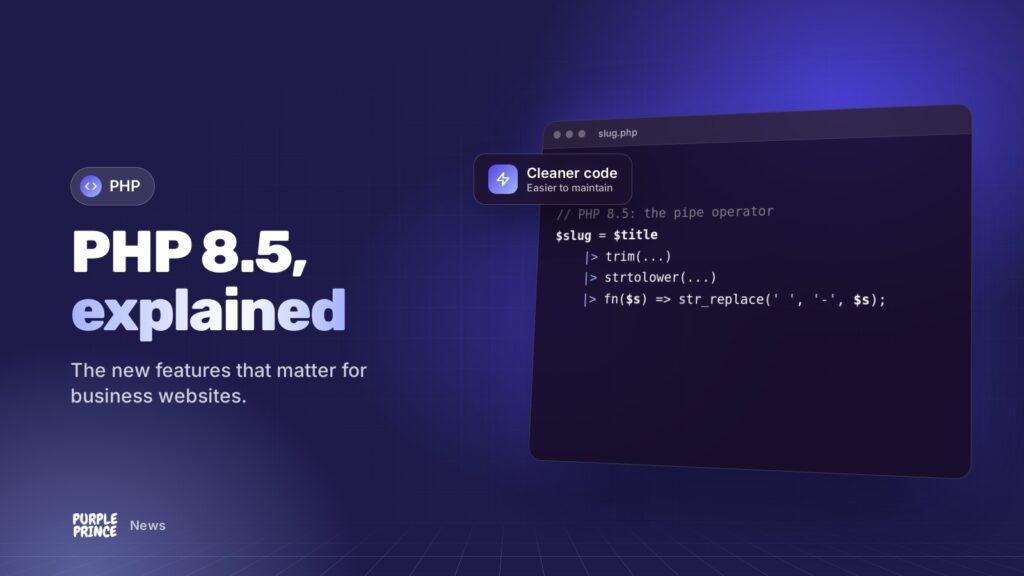
The pipe operator, written |>, lets developers pass a value through a chain of steps from left to right, without inventing a temporary variable for every stage. Think of it like a production line: the value goes in one end, each step does its bit, and the result comes out the other.
For you, the business owner, that means code that’s easier to read. Easier-to-read code is quicker to review, quicker to change and less likely to hide bugs.
The URI extension
A URI is basically a web address. Websites handle them constantly: redirect links, payment callbacks, API calls, tracking parameters. Getting the parsing wrong can cause bugs and, occasionally, security problems.
PHP 8.5 adds a built-in URI extension that understands both the RFC 3986 standard and the WHATWG URL standard (the one browsers follow). In plain terms, PHP can now pick web addresses apart the same way the official rules say it should, without relying on older, looser functions.
Clone with
Developers can now copy an object and change some of its properties in one go. It’s a small thing that makes “read-only” data structures much nicer to work with, which in turn makes code less prone to accidental changes.
The #[NoDiscard] attribute
This one lets a developer mark a function whose result really shouldn’t be ignored. If someone calls it and throws the answer away, PHP warns them. It’s a neat safety net for things like “did this save actually work?”
Handy extras
array_first()andarray_last(): simple functions to grab the first or last item in a list. Small, but they’ll tidy up lots of code.- Backtraces on fatal errors: when something crashes, PHP now shows the trail of what led there, so problems get diagnosed faster.
- Persistent cURL share handles: PHP can keep certain connection data between requests, so sites that call the same external services repeatedly can reuse connections.
Newer PHP isn’t about shiny toys. It’s about code that’s easier to read, quicker to fix and still getting security updates years from now.
Is anything removed or deprecated in PHP 8.5?
Yes, and this is the bit your developer needs to care about. “Deprecated” means “still works, but will be removed later, so stop using it”. A few examples from the official release notes:
- The backtick operator (a shorthand for running shell commands) is deprecated.
- Old cast names like
(integer)and(boolean)are deprecated in favour of(int)and(bool). - Using
nullas an array key is deprecated. - The
disable_classessetting has been removed.
None of that is scary, but it’s exactly why upgrades should be tested on a copy of your site first, not switched on live and hoped for the best.
Why does staying on a current PHP version matter for speed and security?
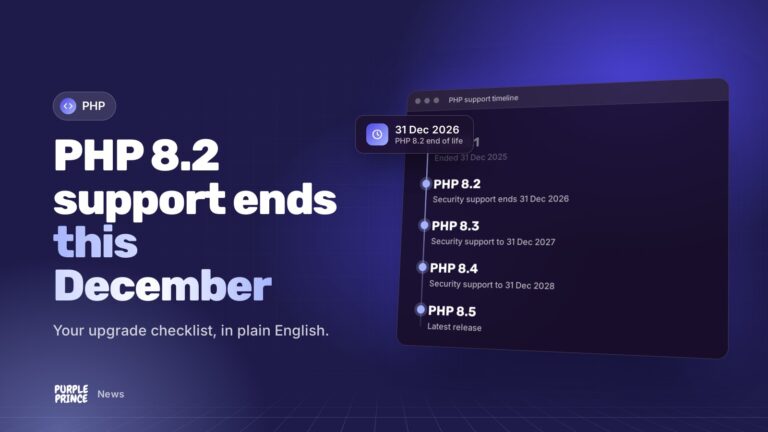
Every PHP version eventually reaches “end of life”, when the PHP team stops fixing security holes in it. PHP 8.1 hit that point on 31 December 2025, and PHP 8.2 follows on 31 December 2026. Sites left on old versions quietly collect risk.
Newer versions also tend to run faster and use resources more sensibly. Quicker pages keep visitors happier, help conversion and do your SEO no harm. And modern plugins, extensions and frameworks increasingly expect modern PHP.
Should my website move to PHP 8.5 straight away?
Not necessarily. The right PHP version is the newest one your whole setup supports: your platform, your theme, your plugins or extensions, and any custom code.
- WordPress currently recommends PHP 8.3 or greater. Most well-maintained plugins cope with newer versions, but check the ones you rely on.
- Magento supports specific PHP versions per release, so check Adobe’s system requirements for your exact version before changing anything.
- Laravel and bespoke PHP apps depend on the framework version and your Composer packages.
Our general advice: if you’re on 8.1 or older, move now. If you’re on 8.2, plan this year. If you’re on 8.3 or 8.4, you’re in good shape, and 8.5 can be part of your next scheduled upgrade.
What does a sensible PHP 8.5 upgrade look like?
- Back up files and database, and check the backup restores.
- Update your platform, plugins and extensions to versions that support PHP 8.5.
- Run the site on a staging copy with PHP 8.5 and test the things that matter: checkout, forms, logins and admin.
- Read the error logs for deprecation warnings and fix them.
- Switch live in a quiet period and keep an eye on things for a few days.
If you’d rather someone else did the heavy lifting, our PHP and Laravel support team handles upgrades like this, and our hosting runs on our own NGINX and PHP-FPM stack, so moving between versions is something we do routinely. Want a hand with your setup? Get in touch.