If your business runs on a Laravel app, there’s a new major version in town. Laravel 13 came out on 17 March 2026, and the good news is it’s one of the gentlest upgrades the framework has ever had.
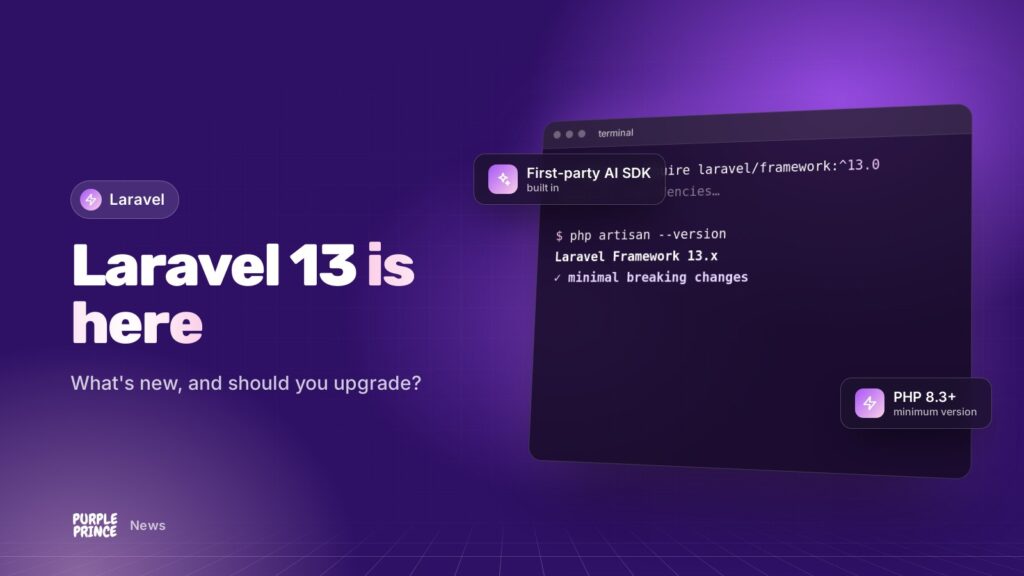
In short: Laravel 13 was released on 17 March 2026. It adds a first-party AI SDK, built-in vector search for PostgreSQL, JSON:API resources and more PHP attributes, with minimal breaking changes. It needs PHP 8.3 or newer, gets bug fixes until Q3 2027 and security fixes until 17 March 2028.
What is Laravel, and why does a new version matter?
Laravel is a popular PHP framework: a toolkit developers use to build web apps such as customer portals, booking systems and internal tools. It handles the boring plumbing (logins, databases, emails, background jobs) so we can spend our time on the bits that make your app yours.
Each major version gets a fixed support window. Once that window closes, the framework stops getting security fixes, and that’s when an app quietly starts to become a risk. So a new release is a good moment to check where your app sits on the timeline.
What’s new in Laravel 13?
The Laravel team describes this release as focused on “AI-native workflows, stronger defaults, and more expressive developer APIs”. Here are the headline changes in plain English.
A first-party AI SDK
An SDK (software development kit) is a ready-made set of building blocks. The Laravel AI SDK gives developers one consistent way to talk to AI providers for text, tool-using “agents”, images, audio and embeddings. Because it’s provider-agnostic, switching AI provider later shouldn’t mean rewriting your app.
Vector search built in
Vector search finds things by meaning rather than exact words. Search for “warm winter jacket” and it can surface a “padded insulated coat”. Laravel 13 adds native support for this using PostgreSQL with the pgvector extension, so smarter search no longer needs a pile of extra tools bolted on.
JSON:API resources
JSON:API is a widely used standard for how apps share data with each other. Laravel 13 now supports it out of the box, which makes it easier to build clean, predictable connections between your app and other systems, such as a mobile app or a supplier’s platform.
Smaller quality-of-life wins
- More PHP attributes (little labels in the code) for configuring controllers, queued jobs, Eloquent models and more, right next to the code they affect.
- Queue routing, so background jobs can be sent to the right queue from one central place.
- Enhanced request forgery protection, which adds origin checks to Laravel’s existing CSRF defences.
Cache::touch(), which extends how long something stays cached without fetching it first.
Is upgrading to Laravel 13 hard?
For most apps, no. Laravel says much of its focus this cycle was “minimizing breaking changes”, and that most applications can move to Laravel 13 “without changing much application code”. That’s a refreshing change from some past upgrades that touched half the codebase.
The easiest upgrade is the one you do while it’s still optional.
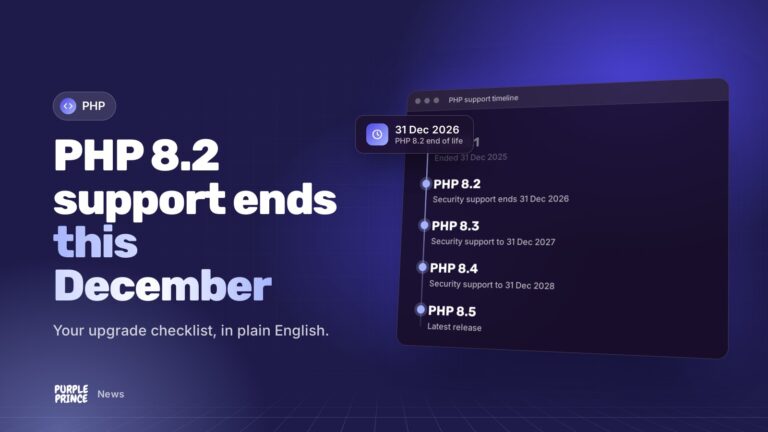
The one hard requirement is PHP. Laravel 13 needs PHP 8.3 or newer. If your server is still on PHP 8.2 or older, that’s the first job, and it’s worth doing anyway because older PHP versions eventually stop getting security patches too.
How long is Laravel 13 supported?
Laravel gives every major release 18 months of bug fixes and two years of security fixes. According to the official release notes:
- Laravel 13: bug fixes until Q3 2027, security fixes until 17 March 2028.
- Laravel 12: bug fixes until 13 August 2026, security fixes until 24 February 2027.
- Laravel 11: security fixes ended on 12 March 2026.
If your app is on Laravel 11 or earlier, it’s no longer getting security fixes, so we’d put an upgrade near the top of your list. On Laravel 12 you’ve got breathing room, but planning the move this year is sensible.
Should my business upgrade to Laravel 13 now?
Here’s a quick way to decide:
- On Laravel 11 or older? Yes, plan it now. You’re outside the security window.
- On Laravel 12 and happy? No rush, but book it in before Laravel 12’s security fixes end in February 2027.
- Want AI features or smarter search? Laravel 13 is the natural place to build them, so upgrade first.
- Relying on lots of third-party packages? Check each one supports Laravel 13 before you jump.
- Server on PHP 8.2 or below? Sort PHP first. It’s a prerequisite.
The technical bit: what should developers check?
If you’ve got an in-house developer, here’s the short checklist we’d hand them:
- Bump PHP to 8.3 or newer on every environment, including local and CI.
- Update
laravel/frameworkto^13.0and work through the official upgrade guide. - Run
composer outdatedand confirm each package has a Laravel 13 compatible release. - Review any custom CSRF handling against the new
PreventRequestForgerymiddleware. - Run your full test suite, then test the money-making bits by hand: checkout, sign-up, invoicing.
- If you’re on PostgreSQL and fancy semantic search, look at
whereVectorSimilarTo()in the query builder.
Don’t feel you need to adopt every new feature on day one. The safe order is: upgrade, check everything still works, then pick the new bits that genuinely help your business.
What does Laravel 13 mean for AI in your app?
This is the exciting bit. With an official AI SDK and vector search built in, adding things like a helpful assistant that answers questions from your own documents, or search that understands what customers mean, gets simpler.
We’re keen to explore that with clients through our AI for business work, always with sensible checks on data and accuracy.
If you’d like help planning a move to Laravel 13, our PHP and Laravel support team know our onions, and we also handle new Laravel development from scratch.
Not sure where your app stands? Get in touch for a no-obligation chat and we’ll tell you straight.